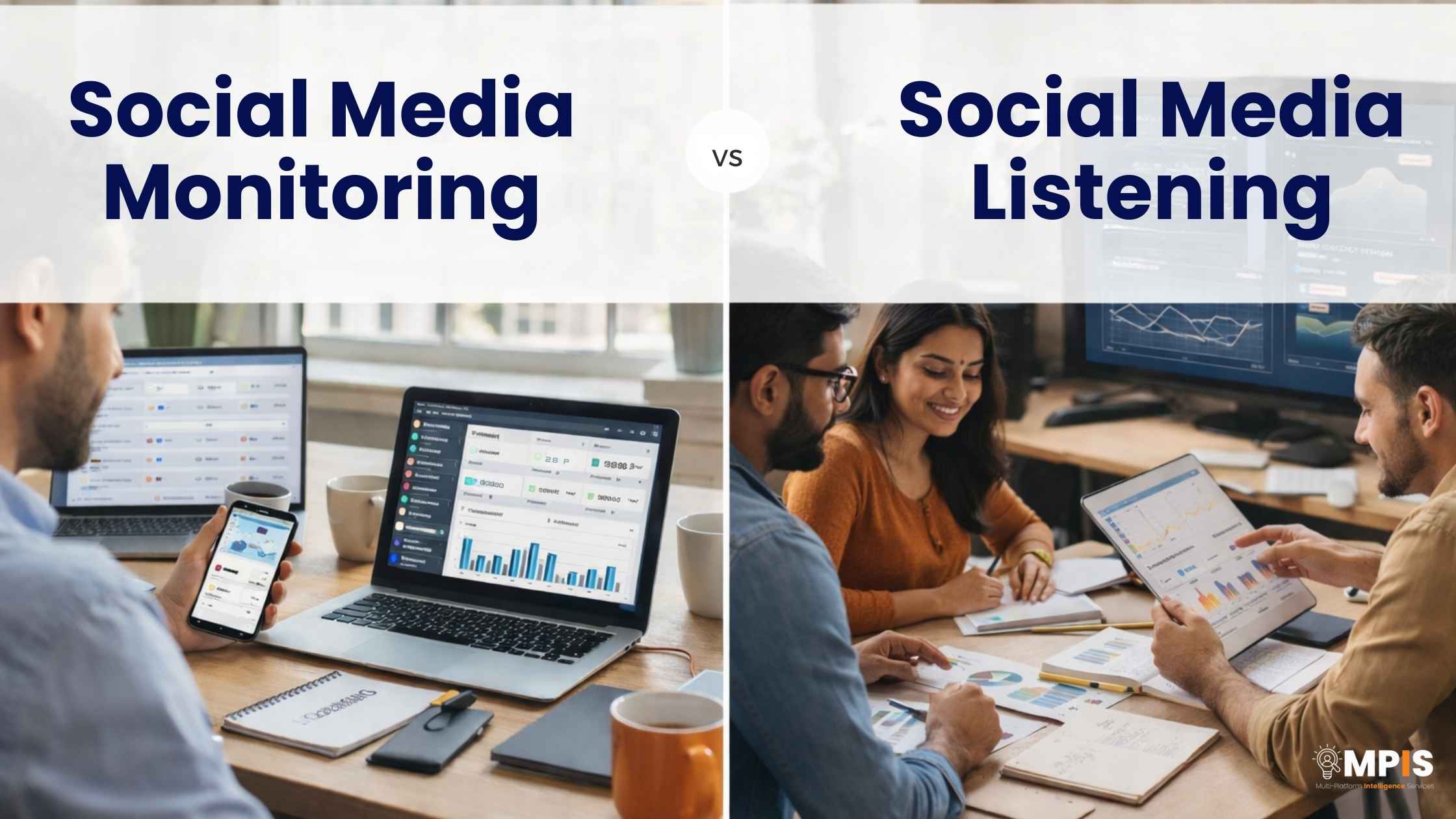
In today’s always-on digital ecosystem, conversations about brands unfold continuously across social platforms, forums, review sites, and digital communities. Opinions don’t wait for quarterly reports. They erupt, ripple outward, and reshape perception in minutes—sometimes seconds. One viral comment can spark loyalty. Another can spiral into a full-blown reputational storm.
We operate in an environment where perception is shaped in real time, opinions travel faster than campaigns, and reputational impact compounds almost instantly. To navigate this reality with confidence—and without flying blind—we rely on two complementary but fundamentally different disciplines: social media monitoring and social media listening.
They’re often lumped together, casually swapped in presentations, or treated as synonyms. Big mistake. When used interchangeably, they dilute impact. When applied correctly—and together—they become a powerful intelligence framework that sharpens decisions, protects credibility, and fuels sustainable growth.
This Social Media Monitoring vs Social Media Listening: A Strategic Guide for Modern Brands breaks down the difference, the value, and the real-world impact of both practices—minus the jargon, plus practical clarity. Let’s dig in.
Why This Distinction Matters More Than Ever
Let’s be honest—digital noise isn’t slowing down. If anything, it’s louder, messier, and more emotional than ever. Brands aren’t just competing on products anymore; they’re competing on interpretation.
- Who understands the audience better?
- Who detects risk earlier?
- Who adapts messaging before sentiment turns sour?
That’s where monitoring and listening step in—but they don’t play the same role. One keeps you alert. The other makes you intelligent.
Defining Social Media Monitoring
What Social Media Monitoring Really Means
Social media monitoring is about real-time visibility and control. We systematically track and capture brand mentions, keywords, hashtags, competitors, products, executives, and campaigns across publicly available digital channels.
In plain terms? Monitoring answers the question:
“What’s happening right now?”
It’s the frontline radar—always scanning, always on.
What Monitoring Enables Us to Do
Through social media monitoring, we can:
- Detect brand mentions the moment they appear
- Identify sudden spikes in conversation volume
- Respond quickly to customer questions, complaints, or praise
- Track engagement metrics at scale
Monitoring delivers operational clarity with speed. No guesswork. No delay. Just immediate awareness of what’s being said, where it’s being said, and how often.
Core Capabilities of Social Media Monitoring
Social media monitoring typically includes:
- Real-time mention tracking across platforms
- Engagement metrics (likes, shares, comments, reach)
- Influencer and journalist identification
- Crisis alerts and escalation triggers
- Campaign performance tracking
It’s inherently reactive—and that’s not a flaw. It’s a feature. Monitoring ensures no critical moment slips through the cracks and no opportunity for timely engagement is missed.
Defining Social Media Listening
Beyond Visibility: What Listening Actually Does
Social media listening goes deeper. Much deeper. Instead of focusing on individual mentions, we analyze conversations at scale to uncover patterns, sentiment, emotions, motivations, and emerging narratives over time.
Listening answers the bigger question:
“Why is this happening—and what does it mean?”
If monitoring gives us data points, listening turns those data points into strategic insight.
What Social Media Listening Allows Us to Understand
Through listening, we’re able to:
- Interpret sentiment and emotional tone
- Understand audience intent and expectations
- Identify recurring themes and unmet needs
- Anticipate reputational risks and market shifts
Listening connects the dots. It reveals not just what people are saying—but why they’re saying it, and how those conversations evolve.
Core Capabilities of Social Media Listening
A mature listening practice includes:
- Sentiment and emotion analysis
- Topic clustering and trend detection
- Audience behavior and mindset analysis
- Competitive narrative benchmarking
- Strategic insight generation for leadership teams
Listening is proactive by nature. It informs long-term strategy, messaging alignment, product positioning, and even internal decision-making. It’s where foresight lives.
Social Media Monitoring vs Social Media Listening: A Strategic Comparison
Here’s where the distinction becomes crystal clear.
| Dimension | Social Media Monitoring | Social Media Listening |
| Primary Focus | Immediate visibility | Strategic insight |
| Time Horizon | Short-term, real-time | Long-term, trend-based |
| Key Question | What is happening? | Why is it happening? |
| Approach | Reactive | Proactive |
| Scope | Individual mentions | Aggregate conversations |
| Output | Alerts, responses, reports | Insights, recommendations, strategy |
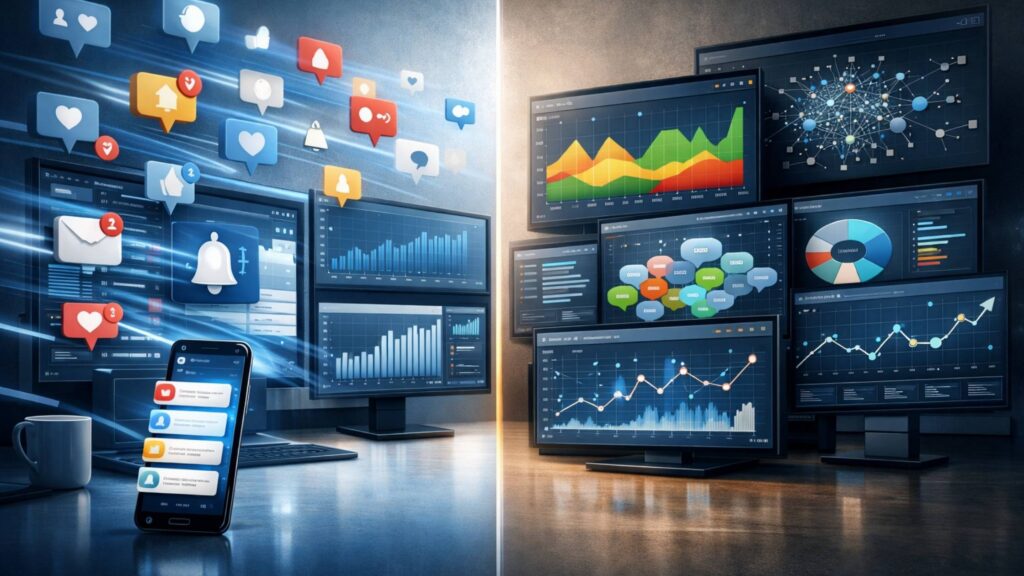
Monitoring operates at a micro level, addressing individual interactions and moments. Listening operates at a macro level, interpreting collective sentiment and behavioral signals across the ecosystem.
Why Social Media Listening Is Business-Critical
Here’s the uncomfortable truth:
Reputation isn’t shaped by what brands say—it’s shaped by what audiences believe and repeat.
Social media listening gives us early visibility into perception shifts before they explode into crises, lost trust, or declining relevance.
Through consistent listening, we’re able to:
- Strengthen brand credibility and trust
- Identify reputation vulnerabilities early
- Align communication with audience expectations
- Inform product, service, and experience improvements
In purchase-driven environments—where reviews, comments, and social validation heavily influence decisions—listening keeps brands aligned with both emotional and rational drivers of behavior.
How Monitoring and Listening Work Together
High-performing organizations don’t choose between monitoring and listening. They integrate both into a unified intelligence loop.
Here’s how the cycle works in practice:
- Digital conversations emerge across platforms
- Social media monitoring captures mentions in real time
- Alerts trigger engagement or escalation
- Conversation data feeds into listening systems
- Listening uncovers insights and patterns
- Strategy and messaging are refined
- Improved decisions influence future conversations
Monitoring provides the signal.
Listening provides the meaning.
Strategy converts meaning into impact.
That’s the real power behind Social Media Monitoring vs Social Media Listening: A Strategic Guide for Modern Brands.
Practical Applications Across Business Functions
Reputation & Risk Management
- Monitoring flags emerging issues instantly
- Listening identifies sentiment shifts that signal deeper risk
Together, they enable early intervention—not damage control.
Marketing & Campaign Optimization
- Monitoring tracks performance metrics in real time
- Listening reveals message resonance and emotional response
Metrics tell us how a campaign performed. Listening explains why it did—or didn’t—work.
Customer Experience & Support
- Monitoring enables fast, visible responses
- Listening uncovers systemic pain points and expectation gaps
Fixing one complaint is helpful. Fixing the root cause is transformative.
Competitive Intelligence
- Monitoring observes competitor launches and activity
- Listening deciphers positioning, narrative dominance, and audience alignment
It’s not just about watching competitors—it’s about understanding why audiences lean toward them.
Common Misconceptions (Let’s Clear These Up!)
- “Monitoring is enough.”
Nope. That’s like reading headlines without understanding the story. - “Listening is only for big brands.”
Wrong again. Smaller brands often gain more from early insight. - “Tools do the thinking.”
Tools collect data. Humans extract meaning.
FAQs: Social Media Monitoring vs Social Media Listening
Is social media monitoring the same as social media listening?
No. Monitoring tracks real-time mentions and metrics. Listening analyzes conversations for deeper insight and meaning.
Do brands really need both?
Absolutely. Monitoring without listening creates blind spots. Listening without monitoring delays action.
Which one helps prevent crises?
Both. Monitoring catches early warning signs. Listening identifies underlying sentiment shifts that cause crises in the first place.
Can listening influence product development?
Yes! Listening often reveals unmet needs, frustrations, and feature gaps before surveys ever do.
How often should brands listen?
Continuously. Sentiment doesn’t run on schedules—and neither should insight.
Choosing the Right Approach for Sustainable Impact
Organizations that rely solely on monitoring stay operationally aware—but strategically blind. Those that invest in listening gain foresight, relevance, and narrative control.
The highest-performing brands embed both practices into their decision-making frameworks. They don’t just react faster; they think smarter. They anticipate change instead of chasing it.
That’s the edge modern brands can’t afford to lose.
Final Perspective
Social media monitoring and social media listening aren’t interchangeable tactics—they’re complementary intelligence disciplines.
- Monitoring protects the present.
- Listening shapes the future.
When executed together with rigor and intent, they transform digital conversations into durable competitive advantage.
By grounding engagement in real-time awareness and anchoring strategy in deep audience understanding, we don’t just respond to conversations—we lead them.
And that, at the end of the day, is what Social Media Monitoring vs Social Media Listening: A Strategic Guide for Modern Brands is all about.