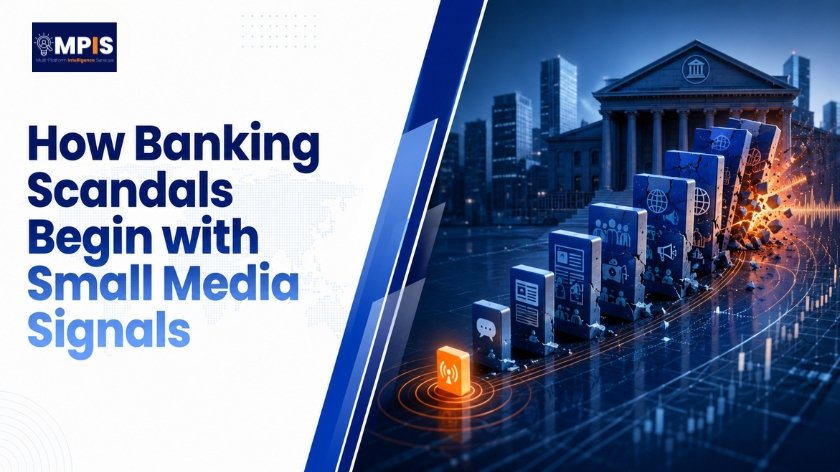
Every major banking scandal in recent memory has a before — a period during which the signals were already present in the media environment, waiting to be read by anyone paying close enough attention.
Before the national headlines. Before the RBI notice. Before the depositor queue outside the branch and the stock circuit breaker kicking in. There were the smaller stories. The regional newspaper report about loan recovery complaints in a specific district. The consumer forum thread accumulating similar accounts of mis-selling. The financial journalist’s question at an investor day that the management team deflected but did not resolve. The Hindi business portal story about regulatory concerns at a branch that appeared once and was not followed up — until six months later, when it became the first paragraph of every national crisis report.
Banking scandals do not erupt from silence. They develop from whispers that become louder in proportion to how long they are ignored. And the institution’s ability to influence how that development unfolds — or whether it unfolds into a full scandal at all — is almost entirely determined by how early those whispers are detected.
This article examines how banking scandals develop from their earliest media signals, what those signals look like and where they appear, and why banking media monitoring is one of the most consequential investments a financial institution can make in its own stability.
The Anatomy of a Banking Scandal: How Small Signals Become National Crises
Banking scandals do not follow a random pattern. They follow a consistent anatomy — a sequence of signal types that appear, compound, and escalate through a predictable series of stages. Understanding this anatomy is what makes early detection possible and what makes the intervention value of banking media monitoring so high.
Stage 1: The Isolated Local Report
The overwhelming majority of major banking scandals in India begin with an isolated story in a regional or local publication — a single complaint, a single branch-level issue, a single customer’s account of mis-selling or recovery harassment. This story is typically short, based on limited sourcing, and appears in a publication with modest circulation. It reaches a small audience. It does not trend. It generates no social media amplification.
At this stage, the story is highly contained and highly addressable. A direct conversation between the bank’s regional communications team and the journalist would typically be sufficient to address factual inaccuracies, provide context that the journalist did not have, or commit to an investigation of the underlying complaint. The bank that detects this story through real-time media monitoring has a genuine opportunity to prevent the story from becoming anything more than what it already is.
The bank that does not detect it has lost the most valuable intervention window in the scandal’s entire development.
Stage 2: Pattern Clustering
If the isolated local report does not receive a response — or worse, if the underlying issue that generated it is not addressed — similar stories begin to appear in other regional publications, on consumer complaint forums, and in social media communities. A second branch complaint. A third. A pattern of similar accounts across different geographies.
At this stage, the individual stories are still manageable. What is changing is not the scale of any single story but the pattern they collectively reveal. A journalist or financial regulator who has been monitoring the bank’s coverage will notice the pattern even if no individual story meets their threshold for a major investigation. The pattern is the story — and at this stage, it is still a pattern that the bank could acknowledge, investigate, and communicate proactively about before a journalist does it for them.
Stage 3: Investigative Journalism Engagement
Once a pattern exists in the media environment — documented across multiple local and regional sources — it becomes the foundation for investigative journalism. A financial journalist at a national business publication begins collecting the regional stories, reaches out to the sources quoted in them, identifies additional complainants, and files a data rights request or contacts a regulatory source.
The resulting investigative article — when it is published — does not feel like a new story. It feels like a revelation of something that was already known, that the bank had not addressed, that multiple individuals had been saying for months. This framing is not incidental — it is accurate. The bank’s absence from the local reporting stages is now embedded in the national story as evidence of either negligence or deliberate avoidance. Neither characterisation serves the bank well.
Stage 4: Regulatory and Depositor Reaction
Once the investigative piece runs in a national publication, the consequences activate simultaneously. RBI’s regional office requests a clarification. The bank’s stock drops. Social media communities begin amplifying the story to depositors. Regional branches report increased withdrawal requests. The bank’s communications team is now managing a multi-front crisis with limited preparation time — responding to regulatory queries, investor calls, social media, and branch operations simultaneously.
The cost of managing the crisis at Stage 4 — in management time, legal fees, regulatory relations effort, communication agency support, and depositor confidence rebuilding — is orders of magnitude higher than the cost of addressing the original local story at Stage 1. And it is entirely a consequence of the signals that were present throughout the development but were not detected.
| Scandal Stage | Media Signal | What Was Being Ignored | When Bank Detected It |
| Stage 1 — Local Signal | Single article, regional or local publication | Branch-level complaint, consumer forum post on the same topic | Detected by national monitoring at Stage 3 or 4 — 3 to 6 months after first signal |
| Stage 2 — Pattern Building | 3-5 similar stories across regional publications | Consumer complaint pattern, social media sentiment shift in specific geography | Still undetected — pattern not visible without regional monitoring aggregation |
| Stage 3 — Investigation | National investigative article published | Pattern of 6 months of regional coverage the bank had not seen | First detection — but narrative fully formed, regulatory attention already active |
| Stage 4 — Full Crisis | Multi-outlet national coverage + social amplification | Depositor concern, stock decline, RBI notice, operational disruption | Full crisis response — prevention no longer possible, only damage management |
The Small Signals That Precede Banking Scandals: A Field Guide
For communications and risk management teams at financial institutions, the critical capability is not recognising a crisis when it is at full scale — that requires no special monitoring. The critical capability is recognising the specific signal types that consistently precede banking scandals, at the stage where they are still quiet and still addressable.
Consumer Complaint Clustering
The most consistent early warning signal for banking scandals is consumer complaint clustering — the appearance of multiple similar complaints about the same product, practice, or branch within a defined time window. A single complaint about loan recovery practices is a customer service issue. Ten complaints about loan recovery practices from the same region, published across local consumer forums and vernacular social platforms within a month, is an early warning signal of systemic mis-conduct.
Negative news monitoring that tracks consumer forum activity, regional social media communities, and complaint aggregator sites — not just mainstream media mentions — provides this clustering intelligence. The pattern detection is what matters: individual complaints remain invisible until they are aggregated and the frequency and similarity analysed.
Regional Journalist Inquiry Patterns
When regional journalists — particularly those covering banking and finance in specific states — begin asking questions about a bank’s operations in their area, they are typically working a story. Their questions may not appear in published coverage immediately. They may appear as social media posts, as questions at press events, as calls to the bank’s regional PR contacts, or as formal information requests.
Banks with systematic banking media monitoring that tracks journalist activity — which journalists are covering what topics in which geographies — can identify when regional financial journalists have begun focusing attention on specific operational or compliance concerns, even before any story is published. This advance intelligence is the most direct form of early warning available, and it is only possible through monitoring that covers the journalistic activity, not just the published output.
RBI and Regulatory Media Commentary
RBI’s public communications — speeches by the Governor and Deputy Governors, annual reports, financial stability reports, regulatory circulars, and press conferences — are rich with signals about the issues the regulator is focused on and the practices it is scrutinising. When RBI begins making increasingly pointed public statements about specific banking practices — digital lending, mis-selling of investment products, NPA recognition, governance standards — it is typically a signal that the regulator’s formal attention has shifted toward those practices.
Financial institutions that monitor RBI’s public media engagement — not just the formal regulatory communications but the speeches, interviews, and committee appearances — have advance notice of the regulatory priorities that will eventually translate into supervisory action. This regulatory media intelligence is directly relevant to the bank’s own risk and compliance posture, not just its communications function.
Whistleblower and Employee Media Activity
Employees who have concerns about a financial institution’s practices sometimes communicate those concerns through media channels before or after exhausting internal channels. This might appear as anonymous comments on financial journalism platforms, as background information to investigative journalists, as social media posts from accounts that are difficult to trace to current employees, or as formal whistleblower complaints that generate regulatory media coverage.
Financial media monitoring that tracks industry-specific platforms — banking and finance journalism communities, LinkedIn discussions among financial professionals, anonymous employee review platforms — provides early warning of internal concerns that are beginning to find external expression. These signals are often the earliest available indication that a compliance or governance issue exists that has not yet been addressed internally.
Vernacular Social Media Sentiment Shifts
In India’s banking sector, where a significant proportion of depositors and borrowers are not English-language digital media consumers, the earliest consumer sentiment signals about banking issues often appear in vernacular social media communities — Hindi Facebook groups discussing loan difficulties, Tamil WhatsApp channels sharing experiences of branch-level service failures, Marathi Twitter communities amplifying complaints about specific banking practices.
These vernacular social signals are almost entirely invisible to banking communications teams that monitor only English-language social media. But they are where depositor and borrower sentiment forms — and where the early warning signals of a depositor confidence crisis are most clearly visible before they reach mainstream media. Real-time media monitoring that covers vernacular social platforms provides this early depositor sentiment intelligence that English-only monitoring cannot access.
Why Banking Scandals Are Uniquely Consequential When They Develop Undetected
Banking scandals are not simply reputation crises that happen to affect financial institutions. They carry a specific set of consequences that make early detection — and early prevention — especially valuable compared to any other industry.
The Depositor Confidence Cascade
When a banking scandal reaches national media coverage, the primary risk is not the reputational damage to the brand — it is the depositor confidence cascade. Depositors who read about governance failures, fraud allegations, or regulatory concerns at their bank do not wait for the story to be resolved before deciding whether to keep their deposits in place. The rational response to uncertainty about a bank’s safety is to withdraw first and reassess later.
This depositor response creates a liquidity dynamic that transforms a media story into an operational crisis with a speed that no other sector faces from media coverage. A bank that is managing a media story about governance concerns becomes a bank managing a liquidity stress when that story reaches enough depositors quickly enough. The media story and the financial stress are not sequential — they are simultaneous and mutually reinforcing.
The Regulatory Activation Speed
RBI’s supervisory response to banking sector media coverage is faster and more consequential than the regulatory response most other sectors face. RBI tracks media coverage of financial institutions as part of its ongoing supervisory surveillance — a critical article in a national business publication about a bank’s governance practices or compliance posture can trigger a request for information within hours and a supervisory visit within days.
This regulatory activation speed means that the interval between a banking scandal reaching national media and a bank facing formal regulatory engagement is very short — too short for a reactive communications strategy to establish any useful framing before regulatory attention has already been focused. The only effective response to this speed is proactive monitoring that detects the media story before it reaches national scale, at the stage where the bank can still address the underlying concern before regulatory attention is triggered.
The Investor and Rating Agency Response
Listed banks and financial institutions face an additional consequence dimension: the investor and credit rating response to banking scandal coverage. Analyst reports referencing negative media coverage about governance or compliance issues, credit rating agency reviews citing media concerns, and institutional investor queries prompted by national media stories all activate within the news cycle of the original coverage.
A banking scandal that breaks on a Monday morning can affect a bank’s stock price, trigger analyst downgrades, and prompt rating agency reviews by Tuesday — creating a financial markets pressure that amplifies the original reputational damage and introduces new communication requirements around investor relations that the communications team must manage simultaneously with the media crisis.
The Regional Media Dimension: Where Banking Scandals Start in India
A defining characteristic of banking scandals in India is their geographic origin. The practices that eventually generate national banking crises — mis-selling of financial products to rural borrowers, aggressive loan recovery practices in specific districts, branch-level fraud, inappropriate credit assessment — are operational-level issues that occur in specific geographies and are first reported in the regional language media of those geographies.
National English business media — the Economic Times, Business Standard, Mint — does not generate banking scandals. It reports them. The stories that become national banking crises are discovered and first published by local correspondents covering specific districts, state financial journalists covering state-level banking operations, and regional language business media covering the financial services sector in their geographic areas.
The Hindi Belt Banking Story
India’s largest banking consumer base — in terms of both depositor numbers and borrower count — is in Hindi-speaking states. Uttar Pradesh, Bihar, Madhya Pradesh, Rajasthan, and Jharkhand collectively represent hundreds of millions of bank account holders, the vast majority of whom are served by public sector banks, regional rural banks, cooperative banks, and the rural operations of private banks.
Banking complaints, fraud reports, and mis-selling allegations from these geographies are covered first and most comprehensively by Hindi-language regional media — Dainik Jagran, Dainik Bhaskar, Amar Ujala, Hindustan, and their district sub-editions. A bank whose communications programme does not include systematic monitoring of Hindi regional business and financial coverage is operating with a fundamental blind spot in the geography where its greatest consumer exposure is concentrated.
The Cooperative and Regional Bank Specific Risk
For cooperative banks, regional rural banks, urban cooperative banks, and small finance banks — whose operational geography is inherently regional — the regional media blind spot is even more consequential. The banking journalism that covers these institutions is almost entirely in regional languages. Their regulators — state cooperative department supervisors, NABARD, and state-level RBI regional offices — communicate and respond primarily in the context of regional media.
A cooperative bank in Maharashtra that does not monitor Marathi-language banking journalism, or a regional rural bank in Andhra Pradesh that does not track Telugu financial media, is operating without the intelligence layer most relevant to its specific regulatory and reputational risk environment. Bank reputation management at the regional institution level is inseparable from regional language media monitoring.
The Mis-Selling Scandal Pattern: A Case Study in Signal Accumulation
Financial product mis-selling is one of the most persistent sources of banking scandals in India — and it provides the clearest illustration of how small signals accumulate into national crises when monitoring is absent.
Mis-selling scandals almost universally follow this pattern. The bank’s retail distribution network sells a financial product — an insurance product bundled with a loan, a investment scheme marketed as a fixed deposit equivalent, a pension product sold without adequate risk disclosure — to customers who do not fully understand what they are purchasing.
The initial complaints are isolated and local. A customer in a specific branch complains to a consumer forum about a product they did not understand. A local journalist covers the complaint. The bank does not detect the coverage. The complaint is not investigated at the operational level. The practice continues.
How the Pattern Builds
Over the next six to twelve months, similar complaints appear across multiple branches in multiple states. Consumer advocates begin aggregating the complaints. A state consumer court issues an order in a similar case. An RBI regional office receives a complaint and adds it to its supervisory file. A regional financial journalist begins investigating the pattern.
None of these developments generates national coverage on its own. Each one is a small signal in a regional media environment that the bank is not monitoring. Cumulatively, they are building the foundation of what will become a national investigation when a financial journalist at a major publication discovers the pattern and uses the accumulated regional reporting as the evidentiary base for a national story.
The national story — when it publishes — typically references six months of consumer complaints, multiple regional court cases, a pattern of similar allegations across states, and an RBI regional office concern that was never publicly announced but becomes known through the journalist’s sources. The bank has lost six months of intervention opportunities because its monitoring programme did not see any of the regional signals accumulating.
| THE MIS-SELLING SIGNAL TIMELINE → Month 1: First consumer forum complaint. Local publication covers it. Bank unaware.→ Month 2-3: Similar complaints in 3 other states. Consumer advocate begins tracking.→ Month 4: State consumer court ruling in similar case. Regional press covers it.→ Month 5: RBI regional office receives formal complaint. Industry trade media notes it.→ Month 6: Financial journalist discovers pattern. National investigation begins.→ Month 7: National investigative article published. RBI notice. Stock decline. Crisis active. Seven months of detectable signals. Zero interventions. One avoidable national banking scandal. |
What Effective Banking Media Monitoring Requires
For financial institutions that are serious about detecting banking scandal signals at the stage where they are still addressable, the monitoring programme must be built around the specific characteristics of how banking issues develop in India’s media environment.
| Monitoring Layer | What to Track | Scandal Type Detected |
| National English financial media | Business dailies, financial portals, wire services, RBI press releases, SEBI notifications, investor reports citing media | Mainstream banking scandals, regulatory action coverage, investor sentiment crises |
| Hindi regional financial media | Dainik Jagran banking correspondents, Dainik Bhaskar financial coverage, Hindi business portals by state | Rural banking complaints, loan recovery issues, public sector bank problems |
| State language financial media | Marathi, Gujarati, Telugu, Tamil, Kannada, Malayalam business and banking journalism | Cooperative bank issues, regional private bank problems, state-specific mis-selling |
| Consumer complaint platforms | Consumer courts media coverage, NBFC complaint forums, banking ombudsman case coverage, financial consumer social media | Mis-selling pattern detection, loan recovery harassment signals, fraud complaint clustering |
| Regulatory body communications | RBI speeches, Governor/Deputy Governor interviews, RBI annual reports, SEBI, IRDAI, NABARD communications | Regulatory focus shift signals, supervisory priority indicators, compliance risk alerts |
| Financial journalism community | Financial journalist Twitter/X activity, LinkedIn financial analyst discussions, banking sector journalism community | Investigation in progress signals, journalist inquiry patterns before publication |
| Investor and analyst media | Analyst reports, rating agency communications, institutional investor media, Bloomberg/Reuters financial coverage | Investor sentiment crises, credit rating concern signals, market confidence issues |
| Social media — vernacular | Hindi/Marathi/Telugu/Tamil banking community Facebook groups, WhatsApp banking consumer channels | Depositor sentiment early warning, branch-level complaint amplification, viral banking crises |
The RBI Regulatory Media Intelligence Function
For banks, the single most valuable specific monitoring function is regulatory media intelligence — systematic tracking of how RBI communicates publicly about issues relevant to the bank’s operations, product portfolio, and compliance posture. RBI’s public communications carry substantial forward-looking intelligence that most banks underutilise.
When the RBI Governor makes public statements about specific banking practices — digital lending guardrails, NPA recognition standards, governance requirements for board composition — these statements are not only policy commentary. They are signals of where supervisory attention is focused. A bank that tracks these public signals and assesses their relevance to its own operations has advance warning of the supervisory priorities that will eventually translate into formal examination questions.
Financial media intelligence that covers RBI’s complete public communications — not just formal circulars but speeches, press conference statements, media interviews, and committee testimonies — provides this supervisory advance intelligence in a form that compliance and communications teams can act on before the examination rather than during it.
The Competitor Monitoring Dimension
Banking scandals frequently have a category contagion effect — when a major bank faces a crisis related to a specific product or practice, RBI’s supervisory attention turns to the entire sector, and media coverage begins examining whether other banks have similar issues. A bank that monitors competitor banking scandal coverage proactively — not just its own media — has advance warning of the category scrutiny that will inevitably turn toward its own operations when a peer institution’s crisis generates regulatory and media focus on the practice category.
Crisis media monitoring for banking institutions should therefore include competitive monitoring that covers peer institutions in the same asset size, product profile, and geographic concentration as the monitoring bank. When a competitor’s mis-selling crisis is generating national coverage, the question every financial journalist and regulator is next asking is ‘who else does this?’
The Morning Intelligence Brief: Why 8:30 AM Matters for Banks
For banking institutions, the morning intelligence brief serves a function that is qualitatively different from its value to most corporate communications teams. Banks open for business with the public from the moment branches open — and the information environment their branch staff, call centre teams, and relationship managers are operating in from 9 AM onwards is directly shaped by what the media has said overnight and in the morning.
A branch manager who is not aware of a critical report about the bank’s loan recovery practices that appeared in the morning’s regional newspaper is operating without the information they need to handle the customer who walks in having read that report. A call centre team that has not been briefed on overnight social media criticism of a specific product will be caught off-guard by the volume and tone of the calls they receive from customers who saw the social coverage before calling.
The 8:30 AM intelligence brief is not just a communications function — it is an operational readiness function for banking institutions. The coverage that the brief contains shapes the customer-facing environment that the entire bank will operate in for the rest of the business day.
MPIS India delivers its morning intelligence brief before 8:30 AM every day — covering 450+ publications across 12+ Indian languages, including the regional banking journalism, vernacular consumer media, and RBI public communications that carry the earliest signals of developing banking issues. For financial institutions where the morning’s media coverage directly affects the afternoon’s branch operations, this delivery timing is not a scheduling preference — it is an operational requirement.
| KEY TAKEAWAYS → Banking scandals follow a consistent anatomy — from isolated local signal to pattern clustering to investigative journalism to full crisis — and the intervention window closes progressively at each stage→ The five specific small media signals that consistently precede banking scandals are: consumer complaint clustering, regional journalist inquiry patterns, RBI regulatory media commentary, whistleblower media activity, and vernacular social media sentiment shifts→ Banking scandals are uniquely consequential when undetected because they trigger depositor confidence cascades, regulatory activation, and investor/rating agency responses simultaneously — not sequentially→ In India, most banking scandals originate in regional and vernacular language media — Hindi, Marathi, Gujarati, Telugu, and Tamil financial journalism — that most banks’ monitoring programmes do not cover→ The mis-selling scandal pattern demonstrates that seven months of detectable regional signals typically precede a national banking crisis — the entire sequence is preventable through early detection→ Effective banking media monitoring requires eight distinct coverage layers including vernacular social media, regulatory body communications, consumer complaint platforms, and competitor monitoring→ RBI regulatory media intelligence — tracking the Governor’s and Deputy Governors’ public statements, speeches, and interviews — provides supervisory advance warning that most banks are not systematically utilising→ For banking institutions, the 8:30 AM morning brief is an operational readiness function — branch staff and customer-facing teams need media briefing before they encounter customers who have already read the morning coverage |
Conclusion
The most expensive banking scandals in India were not inevitable. They were the product of small signals that were present, detectable, and addressable — at the stage when a quiet operational response or a proactive communication with a regional journalist would have been sufficient — but that were not seen because the monitoring infrastructure was not watching the right channels.
Banking scandals begin small. They begin in a consumer forum post, a district newspaper paragraph, a regional journalist’s note-taking, a vernacular social media thread. They grow large only when those small signals are not detected, not investigated, and not addressed at the stage when addressing them was still proportionate and manageable.
Banking media monitoring is the infrastructure that prevents this growth. Not by suppressing legitimate journalism or ignoring genuine compliance issues — but by ensuring that financial institutions are the first to know about the signals that precede their crises, with enough time to respond proportionately and enough information to respond accurately.
The banks that avoid major scandals are not the ones with the cleanest operations — though that helps. They are the ones that take the regional newspaper story seriously, investigate the consumer forum thread, respond to the regulatory media commentary, and understand that the quiet signal today is the national headline waiting to be written tomorrow.
Frequently Asked Questions
Q1. How do banking scandals typically develop in India?
Banking scandals in India typically develop through a four-stage anatomy: an isolated local report in a regional or vernacular publication; pattern clustering as similar stories appear across multiple regions; investigative journalism engagement when a national journalist discovers the accumulated regional pattern; and full crisis when national coverage triggers depositor concern, regulatory activation, and investor response simultaneously. The entire sequence from first local signal to national crisis typically takes three to nine months — all of which represents detectable, addressable signals for banks with comprehensive media monitoring.
Q2. What are the early warning signals that precede banking scandals?
The five most consistent early warning signals before banking scandals are: consumer complaint clustering across regional forums and vernacular social platforms; regional journalist inquiry patterns indicating an investigation is developing; increasing frequency of RBI public statements about practices relevant to the bank’s operations; whistleblower or employee media activity on industry platforms; and vernacular social media sentiment shifts in specific geographies. Each of these signals is detectable through banking media monitoring before it reaches national English media coverage.
Q3. Why is regional media coverage especially important for banking media monitoring?
Most banking scandals in India originate in regional and vernacular language media — Hindi business correspondents in North India, Marathi financial journalism in Maharashtra, Telugu banking coverage in Andhra Pradesh and Telangana, Gujarati business media covering Gujarat’s financial sector. These regional publications are where consumer complaints, branch-level fraud, and mis-selling allegations are first documented. National English business media reports banking scandals after they have already been established in regional coverage. Banks that monitor only national English media are monitoring the end of the scandal’s development pipeline, not its beginning.
Q4. How does banking media monitoring help prevent depositor confidence crises?
Banking media monitoring helps prevent depositor confidence crises by detecting the early signal stages of a developing banking issue — consumer complaints, regulatory signals, regional coverage — before they reach the national media coverage that triggers depositor anxiety. A concern detected and addressed at the regional complaint stage remains an operational matter. The same concern that reaches national coverage simultaneously reaches millions of depositors who react by withdrawing funds. The depositor confidence cascade is preventable only by intercepting the story before national scale — which requires monitoring that covers regional channels where banking issues originate.
Q5. What should a banking media monitoring programme include?
A comprehensive banking media monitoring programme should include: national English financial and business media; Hindi and regional language financial journalism across all states of operation; consumer complaint platforms, banking ombudsman coverage, and consumer court media; RBI and regulatory body public communications including speeches, interviews, and press conferences; financial journalism community monitoring for investigation signals; investor and analyst media; vernacular social media covering depositor and borrower communities; and competitive peer institution monitoring for category risk signals. Morning intelligence brief delivery before 8:30 AM is essential for branch operational readiness.